Tool useRepresentation steeringTraining-free

To Think or to Act?

A Single Activation Direction Controls Adaptive Tool Use in LLM Agents

Shuo Yang1Caren Han1Shuhe Wang1,2Eduard Hovy1,3

1The University of Melbourne 2Peking University 3

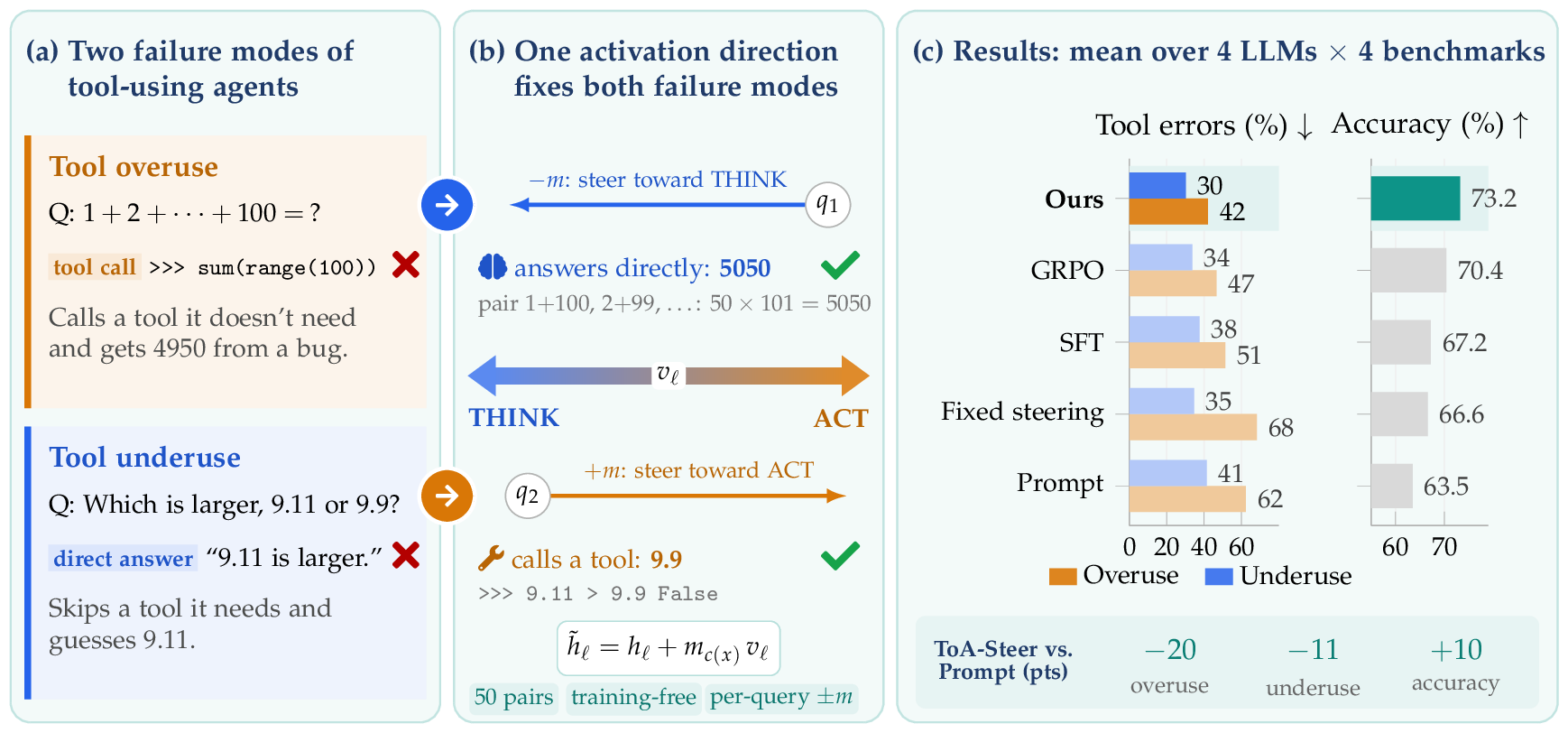
Two failure modes of tool-using agents, one steering direction that fixes both, and results averaged over four LLMs and four benchmarks.
Figure 1. (a) Tool-using LLM agents both overuse tools and underuse them. (b) ToA-Steer shifts activations along one direction with a per-query signed strength m_{c(x)}: toward THINK for q_1, toward ACT for q_2. (c) Averaged over four LLMs and four reasoning benchmarks, it cuts tool overuse by 20 and underuse by 11 points over prompting and gives the highest accuracy, without any parameter updates.
16/16settings with the highest accuracy
+16 / +9points on ACT-needed / THINK-preferred
50contrastive pairs to find the direction
0parameter updates
01

Tool use goes wrong in both directions

A tool call can fix a failed reasoning trajectory when computation or lookup is needed, but it can also add noise or overwrite an answer the model would have produced correctly on its own. The bottleneck for capable agents is not only tool competence but tool-use selectivity: deciding when to think and when to act.

Tool overuse

1 + 2 + ··· + 100 = ?

tool call>>> sum(range(100))✗

Calls a tool it doesn’t need and gets 4950 from a bug.

Tool underuse

Which is larger, 9.11 or 9.9?

direct answer“9.11 is larger.”✗

Skips a tool it needs and guesses 9.11.

02

ToA-Eval: when does a tool help this model?

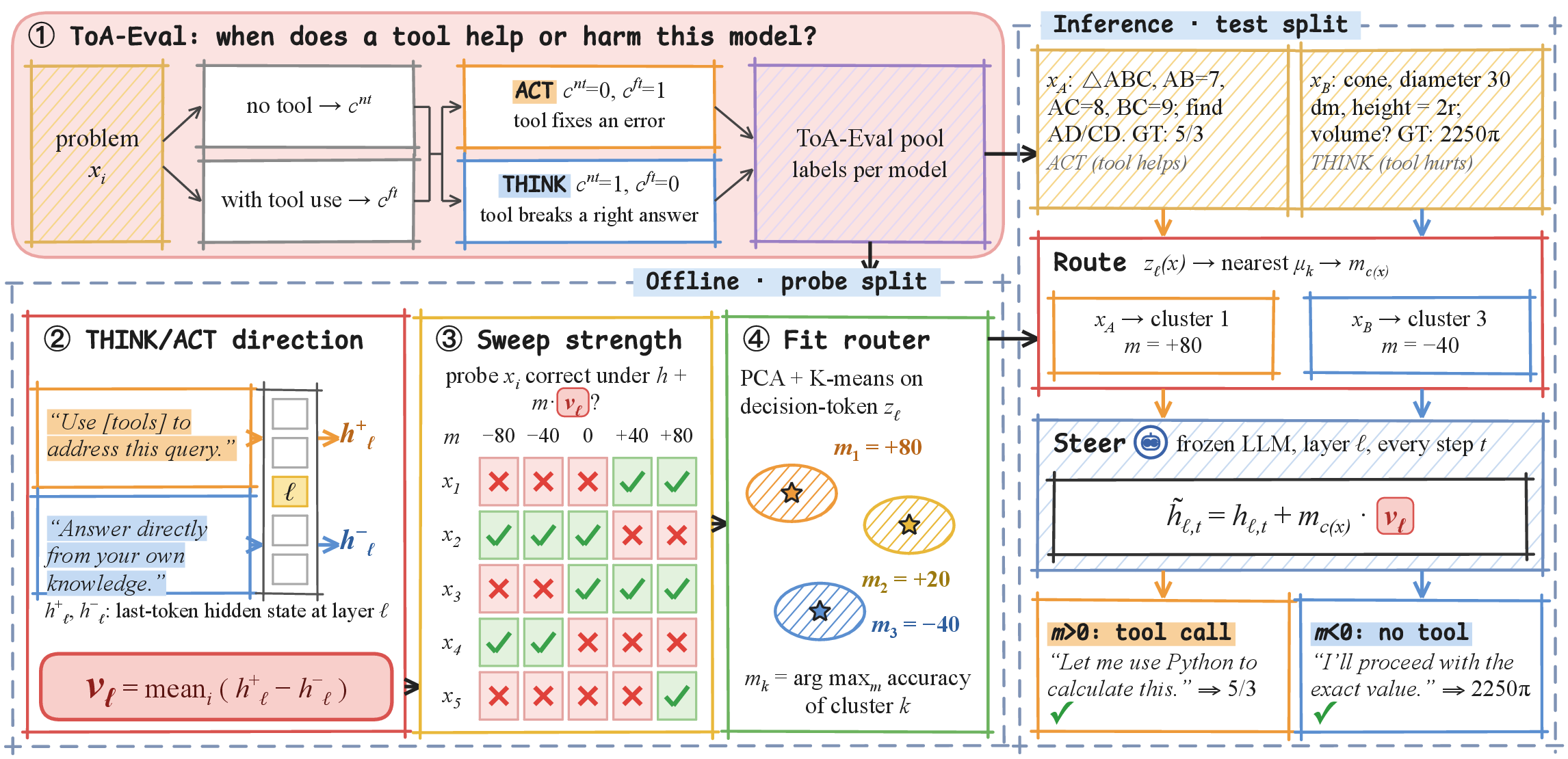
For each problem and each model, ToA-Eval runs two controlled passes of the same base model — one without tools and one that must use a tool — and keeps only the cases where the tool changes the outcome. The same question can need a tool for one model but not another, so labels are derived separately for every model.

with tool ✓
with tool ✗
no tool ✗
ACTtool fixes an error
both wrong
excluded
no tool ✓
both right
excluded
THINKtool breaks a right answer

Instances per model

ACT-needed THINK-preferred

Sources: AIME 2024–2026, MATH, GPQA and MMLU-Pro. Tools: Python execution and Wikipedia search.

03

ToA-Steer: one direction, routed per query

A single static strength cannot serve both classes: ACT-needed inputs must move toward tool use and THINK-preferred inputs away from it. ToA-Steer keeps one shared direction and lets a lightweight router choose the sign and strength for each input.

1

Extract the direction

Two completions share the prompt and differ only in the decision: “Use [tools] to address this query.” vs. “Answer directly from your own knowledge.”

2

Route each query

The decision-token state is projected with PCA and assigned to the nearest K-means centroid; each cluster keeps the signed magnitude with the best held-out accuracy.

3

Steer every step

The same vector is added with the routed sign and strength: m>0 promotes a tool call, m<0 favours answering directly.

Overview of ToA-Eval and ToA-Steer
Figure 2. On the probe split, ToA-Steer labels problems with ToA-Eval, extracts a shared THINK/ACT direction, sweeps the steering strength, and fits a PCA + K-means router. At inference each input goes to its nearest centroid and is steered at every decoding step.
04

Results

ToA-Steer reaches the highest accuracy and the best ACT and THINK tool-call rates in every model–benchmark cell, beating SFT and RL-trained GRPO without any parameter updates.

Main results

Prompting Training-based Static steering ToA-Steer

Averaged over 4 LLMs × 4 benchmarks

Each column’s axis is zoomed to its own range; numbers are exact values.

Full evaluation pool

Accuracy (%) by outcome group, pooled over four models, mean ± SD over five runs. Headroom recovered is the gain over no steering (m = 0) on decision-relevant instances relative to an oracle that always takes the better action.

Does it steer the decision or the whole trajectory?

Overall accuracy (%) on the full pool. Stopping the steering once the model commits to its first action already beats the tuned static baseline on every model.

Transfer to live web search

Calibrated on GPQA with Wikipedia and applied to BFCL V4 Web Search on Qwen3.5-27B without re-calibration.

05

Inside the model

Five findings about where the THINK/ACT decision lives and why routing it per query pays off.

Finding 1 · Depth

The decision is written at a consistent depth

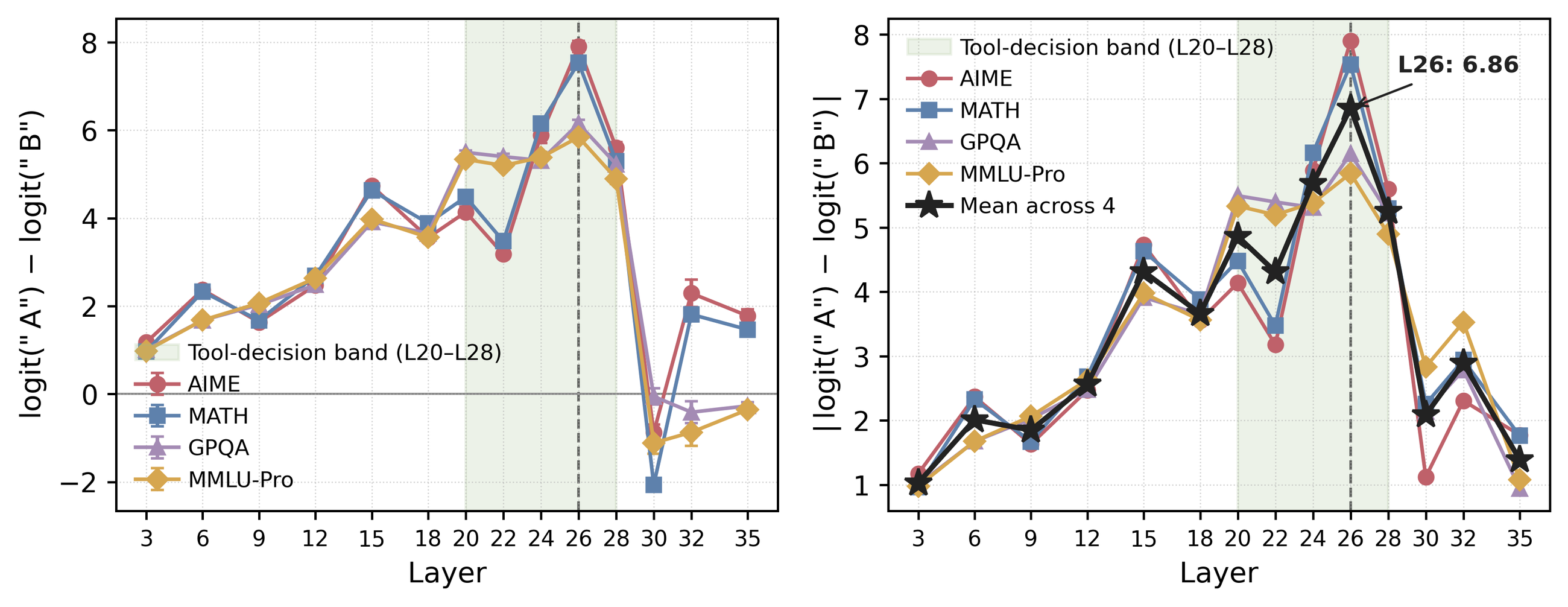
A logit lens at the prompt-end token shows the tool/skip preference staying near zero in early layers, rising across layers 20–28 and peaking at layer 26 on Qwen3-8B. All four models share a similar pattern.
Logit lens across layers
Finding 2 · Structure

Decision regimes form clusters

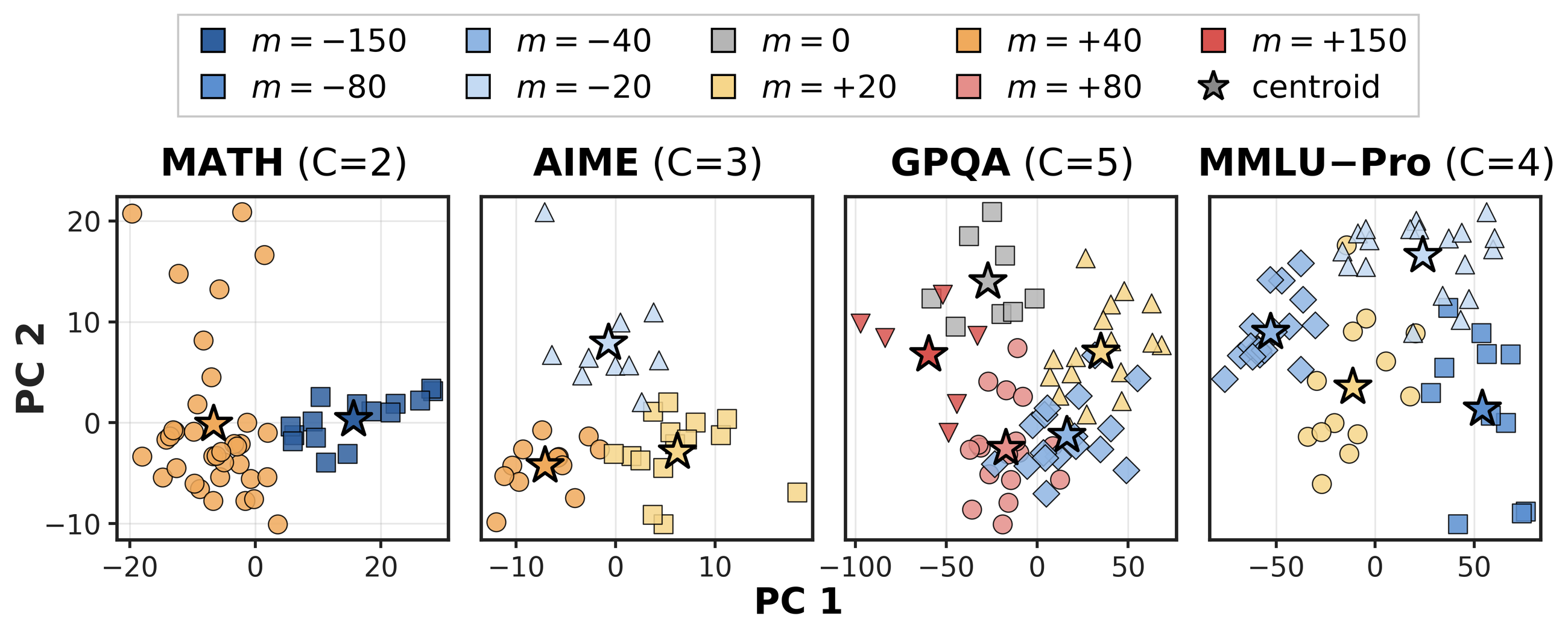
Coloured by the steering magnitude that maximises accuracy, decision-token activations form coherent regions, so an unsupervised partition recovers useful routing groups — from K=2 on MATH to 5 on GPQA.

PCA of decision-token activations
Finding 3 · Control

One direction is a clean control axis

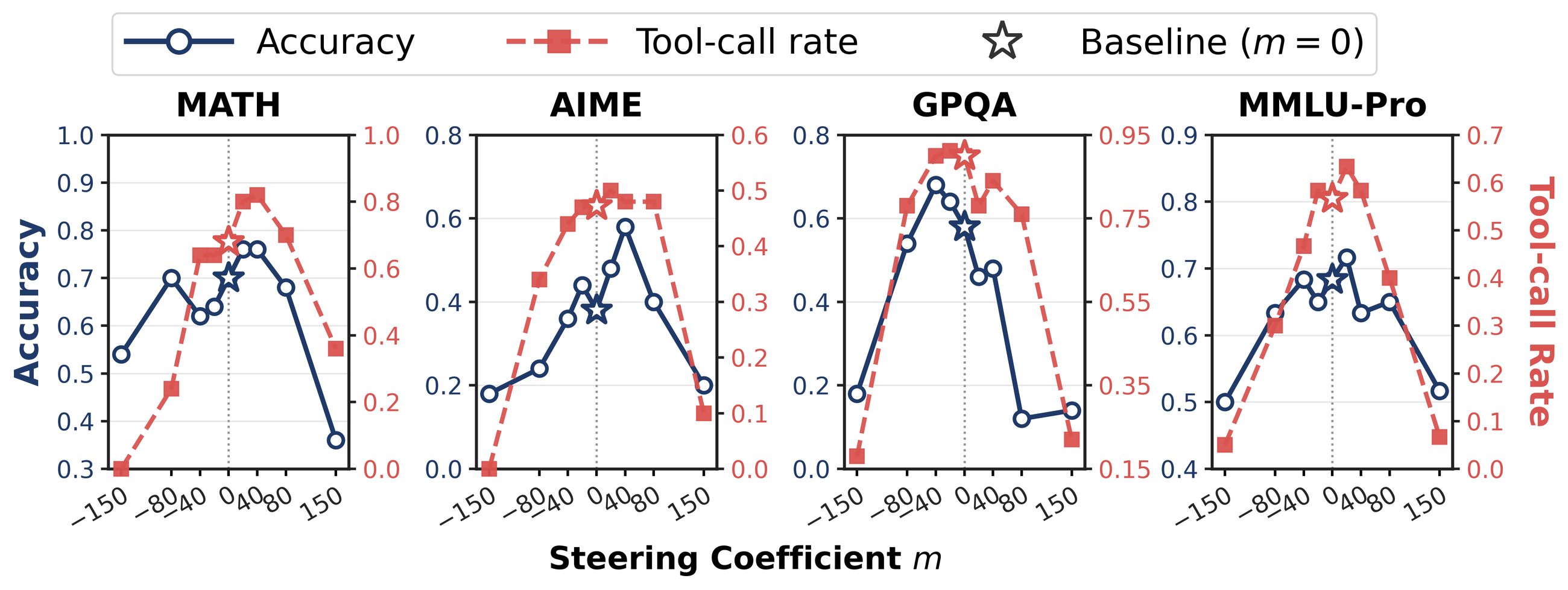
Within a moderate range of |m| the tool-call rate rises smoothly with m, and accuracy peaks away from the no-steer baseline — but at a different m on each benchmark, so no fixed strength is optimal everywhere.

Accuracy and tool-call rate versus steering coefficient
Finding 4 · Both directions

Gains on both classes, at moderate cost

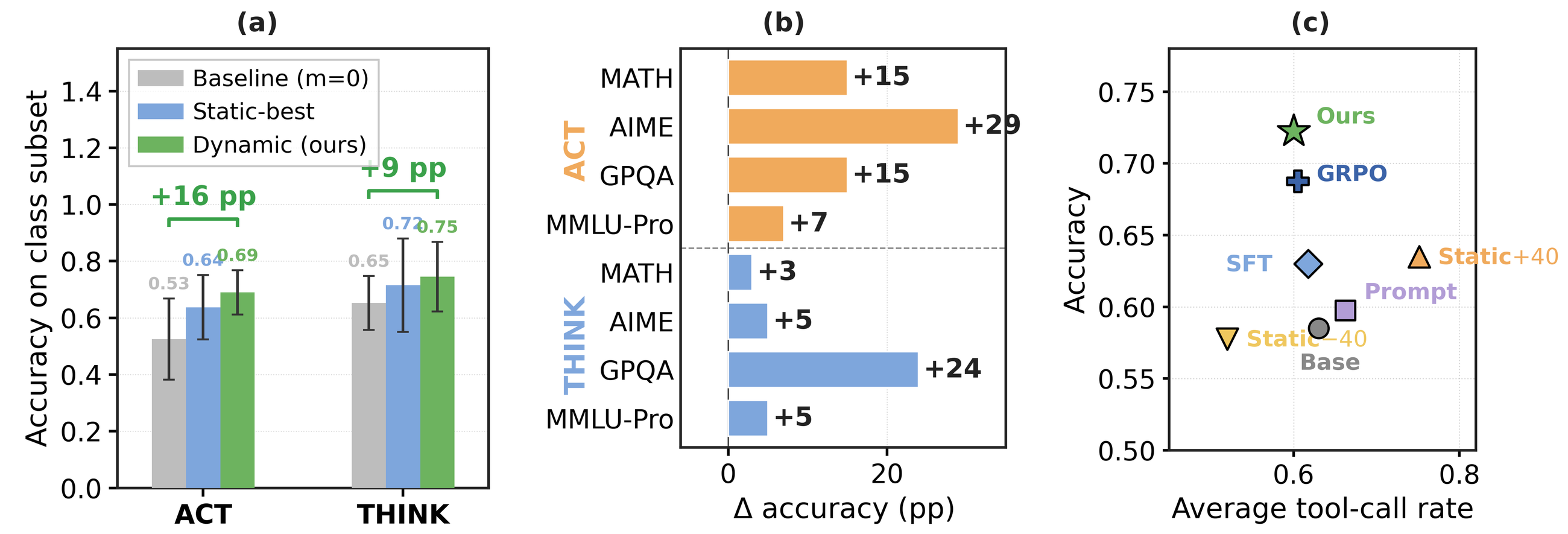
ToA-Steer gains 16 points on ACT-needed and 9 points on THINK-preferred instances, improves both classes on every benchmark, and reaches the highest accuracy at a moderate tool-call rate.

Class- and cost-resolved view
Finding 5 · Headroom

Why route per query

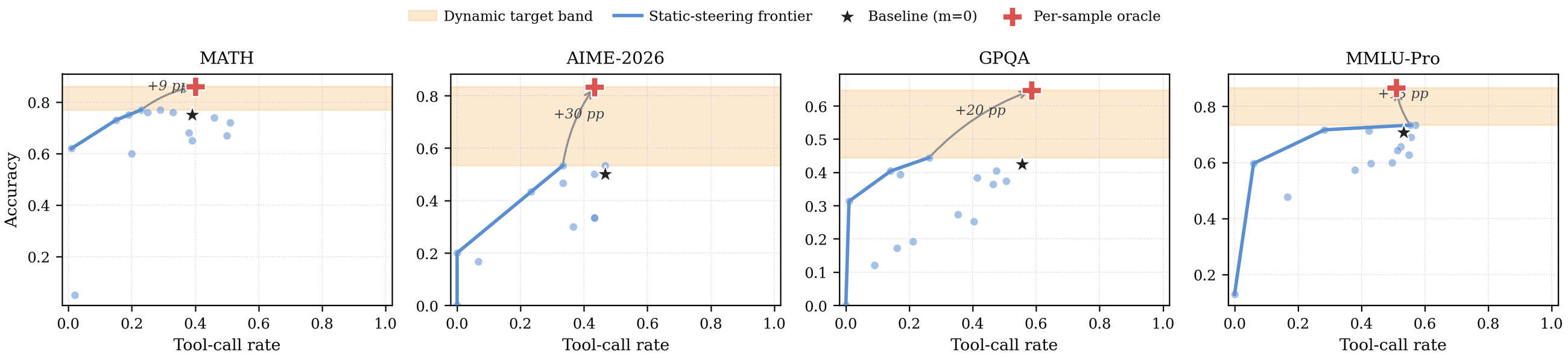
Sweeping a single static magnitude traces a frontier that sits well below a per-sample oracle on every benchmark. This headroom is what per-cluster routing recovers.

Static frontier and oracle headroom
06

Demo

Three problems, three steering strengths, real Qwen3-8B outputs. The same THINK/ACT direction is added with strength m, and the model decides on its own whether to call a tool. Tools are actually executed.

Correct answer
THINK
ACT

Live demoRun ToA-Steer on your own question with Qwen3-8B.
Coming soon
07

Citation

@article{yang2026toasteer,
  title   = {To Think or to Act? A Single Activation Direction Controls
             Adaptive Tool Use in LLM Agents},
  author  = {Yang, Shuo and Han, Caren and Wang, Shuhe and Hovy, Eduard},
  journal = {arXiv preprint},
  year    = {2026}
}